

This content is for informational and entertainment purposes only, not financial advice. Trading involves risk and is not suitable for all investors. This article may contain affiliate links, which means Pro Trading Insights may earn a commission if you sign up through a link. For full details, see our Affiliate Disclosure and Full Disclaimer.
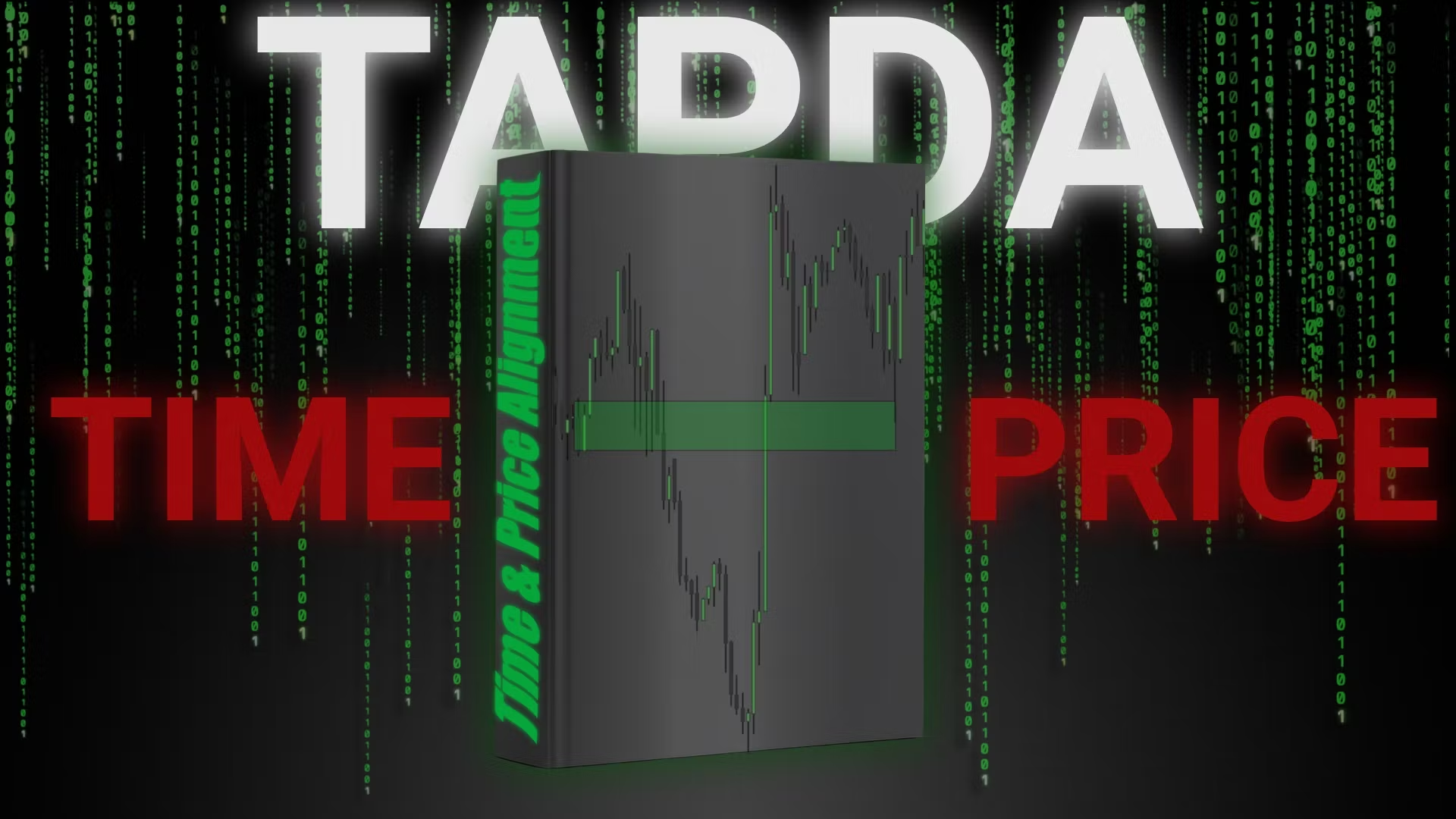
Quick Verdict: TAPDA Indicator is a time-and-price alignment tool connected to The Time Vault ecosystem. The main appeal is simple: it gives chart-based traders a structured way to study when a market is approaching a meaningful area and how price is behaving around that area. Instead of treating every candle as a separate event, TAPDA is built around the relationship between timing, levels, and trade preparation.
Best fit: For someone researching a TAPDA Indicator review, the strongest reason to pay attention is that the tool is not only a visual overlay. The surrounding education helps traders understand how the indicator should be read, how time windows can matter, and why patience matters around execution. It is most relevant for traders who already look at charts but want a cleaner framework for deciding when a setup deserves attention.
Best Fit Snapshot
| Fit Area | Why It Matters |
|---|---|
| Time and price alignment | The tool helps traders connect timing windows with meaningful chart areas instead of reacting to every move. |
| Chart-based trading | TAPDA is most useful for traders who already care about levels, structure, candles, and market timing. |
| Education around the tool | The strongest use comes from learning how the zones are meant to be interpreted rather than treating them as automatic signals. |
| Beginner-to-intermediate development | The concepts can help newer traders build patience while giving experienced traders another structured lens. |
Table of Contents
I. TAPDA Indicator Overview
TAPDA Indicator stands for a time-and-price style of analysis. The core idea is that a market setup becomes more meaningful when price reaches an important area at a useful time, with enough structure to justify attention. That is different from a simple buy or sell arrow. It asks the trader to read context first.
The product is tied to The Time Vault and Nautilus branding, which gives the tool a clearer identity than many anonymous indicators. The visual materials around TAPDA show time-and-price language, multi-time-frame examples, and chart zones. That makes the tool especially relevant for traders who want a repeatable chart routine instead of a random indicator stack.
The important distinction is that TAPDA should be used as a decision-support tool, not a replacement for judgment. A colored zone or time window can make a chart easier to interpret, but the trader still needs to evaluate trend, liquidity, session behavior, risk, and whether the setup fits their rules. Used correctly, the indicator can help slow the process down instead of speeding a trader into emotional entries.
For broader comparison, ProTradingInsights’ guide to top crypto trading Discord servers can help readers compare communities by alerts, education, market focus, and member support. The trading psychology guide is also a useful companion because any trading community works best when members already have rules for sizing, invalidation, and review.
II. How TAPDA Indicator Works
Time windows and chart zones
The most important concept behind TAPDA is alignment. A trader is not only asking whether price is at a level. They are asking whether price is at a level during a window where a reaction may matter. That can help reduce one of the biggest problems in chart trading: staring at the market all day and assuming every movement is equally important.
For beginners, time-and-price alignment can be a helpful way to understand patience. Many newer traders see a level and immediately want to act. TAPDA encourages a more deliberate question: is price reaching the area in a way that makes sense, or is the chart still developing? That shift can help a trader avoid forcing trades before the setup is ready.
Multi-time-frame context
The TAPDA materials include multi-time-frame and single-time-frame language. That matters because traders often get lost when one chart looks bullish and another looks messy. A multi-time-frame lens can help organize the trade idea. A higher time frame may define the bigger area, while a lower time frame may help study timing, reaction, and execution.
The practical benefit is not complexity for its own sake. It is a cleaner process. A trader can first identify the broader context, then use the tool to watch whether the active chart is lining up with that context. This makes the indicator more useful for planning than for chasing.
Education alongside the indicator
An indicator is only as useful as the trader’s ability to interpret it. TAPDA becomes more valuable when paired with education around why a zone matters, how to read price behavior near a zone, and how to avoid turning the tool into a blind entry system. This is where the Whop-style product format can be useful: the tool, community access, and learning path can live close together.
For a trader who has tried many indicators, this point matters. The goal is not to add another object to the chart. The goal is to simplify decision-making. TAPDA is most compelling when it helps a trader remove low-quality opportunities, wait for better alignment, and document why a setup did or did not deserve action.
III. How It Fits Different Trader Levels
Beginner traders
Beginner traders can use TAPDA as a way to learn patience and structure. The biggest mistake for new traders is often not a lack of tools. It is the inability to decide when the market is actually setting up and when it is just moving. TAPDA’s time-and-price focus can help beginners build a more organized checklist.
A beginner should start slowly. Learn what the zones mean, what a time window is supposed to help with, and how the chart behaves when a setup fails. The best first goal is not to trade every signal. It is to understand how the tool frames market behavior.
Intermediate traders
Intermediate traders may find TAPDA more immediately useful because they already understand support, resistance, trend, and basic execution. For this group, the indicator can become a timing layer. It can help filter whether a familiar setup is happening at a stronger or weaker moment.
The best approach is to compare TAPDA with your existing plan. If your normal analysis and the indicator align, the setup may deserve deeper review. If they conflict, that can be a reason to pause instead of forcing the trade.
Advanced traders
Advanced traders may not need TAPDA to understand chart structure, but they may still use it as a visual discipline tool. Experienced traders often benefit from anything that keeps the process consistent. A defined time-and-price framework can help keep the chart from becoming a collection of random impressions.
For advanced users, the value is selectivity. The indicator should help identify when the chart has enough alignment to fit an existing plan. It should not replace risk rules, position sizing, or the trader’s own market read.
IV. Public Review Themes
The strongest review themes around TAPDA focus on clarity, teaching style, and the usefulness of time-and-price concepts. Reviewers tend to highlight that the ideas are easier to understand than expected, and that the education helps them think more clearly about price behavior. That matters because a technical tool needs explanation to become practical.
Another positive theme is the connection to Nautilus and The Time Vault. Traders who have already followed that style of education may see TAPDA as an extension of a broader process rather than a standalone chart gadget. That can make the tool easier to trust and easier to use consistently.
The most useful takeaway is that TAPDA appears to appeal to traders who want structure. It is not positioned as entertainment, and it is not best understood as a one-click answer. The benefit is the combination of visual chart guidance and education around timing, price, patience, and decision quality.
V. How To Use TAPDA Indicator Well
The best way to use TAPDA is to build a routine around preparation, observation, and review. Before the session begins, mark the markets you care about and decide which time frames matter. If you trade futures, for example, you may want a higher-time-frame area and a lower-time-frame execution chart. If you trade forex or crypto, you may want to identify the session and volatility conditions first.
Once the chart is active, use the indicator to slow down. Ask whether price is near a meaningful area, whether the timing makes sense, and whether the reaction is clean enough to study. A tool that makes you more patient is usually more valuable than a tool that makes you click faster.
It also helps to keep notes. Record the time window, the level, the market condition, the reaction, and whether the trade idea followed your plan. Over time, those notes show whether TAPDA is improving your selectivity or just adding another layer to the chart. The best tools reveal patterns in your behavior as much as patterns in the market.
For newer traders, one practical approach is to watch first and trade later. Spend time seeing how the zones behave during active sessions. Watch what happens when price reaches a level cleanly, what happens when it slices through, and what happens when the market becomes choppy. This turns the indicator into a learning tool instead of a shortcut.
For more experienced traders, the best use is integration. Keep your normal rules, then use TAPDA to refine timing and context. That way the tool supports a plan that already exists instead of becoming the entire plan.
VI. Why The TAPDA Indicator Format Works
TAPDA works as a review topic because it has a specific promise. Many trading tools are vague. TAPDA is easier to explain because the core idea is time and price. That gives the article and the trader a clear framework: what does the indicator show, how should it be read, and what kind of trader is likely to benefit from it?
It also has long-tail search value. Someone may search for TAPDA Indicator review, TAPDA Indicator Whop, The Time Vault TAPDA, or time and price alignment indicator. a useful review needs to answer all of those angles without stuffing the page with repeated phrases. The content should explain the concept in plain language, then show how it fits real trading routines.
The conversion case is strongest when the benefit is framed honestly. TAPDA can help traders organize chart timing, study price behavior, and learn a more patient process. It cannot remove market risk, and it should not be treated as an automatic trade generator. That accurate framing makes the recommendation more credible.
VII. Extra Context For Traders Comparing TAPDA
The easiest way to misunderstand TAPDA is to compare it with simple indicator products that only add arrows, colors, or momentum labels. TAPDA is more interesting when it is treated as a timing and structure framework. A trader still needs to decide whether the market is trending, ranging, reversing, or chopping. The indicator can help organize the moment, but the trader’s context still matters.
For futures traders, TAPDA may be useful when studying fast-moving contracts where timing is important. A market can reach a level and still fail to react if the session context is wrong. A time-and-price framework can help a trader avoid entering just because a level exists. It encourages waiting for the level, the time, and the price behavior to make sense together.
For forex traders, the same idea applies around sessions. A level during a quiet period may behave differently than a level during a more active window. TAPDA can help frame that distinction, especially for traders who already think about session timing, liquidity, and intraday structure.
For crypto traders, the tool may be more useful as a discipline filter than a prediction engine. Crypto can move around the clock, which makes it easy to overtrade. A structured time-and-price routine can help a trader decide when to pay attention and when to step away.
The most important benefit is repeatability. If a trader can review the same types of zones, the same timing logic, and the same market reactions over many sessions, the tool becomes part of a measurable process. That is much stronger than using it emotionally only when the chart looks exciting.
Final Take
TAPDA Indicator is a strong fit for traders who want a clearer way to study time, price, chart zones, and trade preparation. It is especially relevant for people who already care about technical analysis but want a more structured process for deciding when a setup is worth attention.
If you want an indicator connected to education, timing logic, and chart-based discipline, TAPDA Indicator is worth a closer look.
Frequently Asked Questions
What is TAPDA Indicator?
TAPDA Indicator is a trading tool focused on time and price alignment, helping traders study chart zones, timing windows, and market structure.
Is TAPDA Indicator good for beginners?
It can be useful for beginners who want to learn patience and chart structure, as long as they study the education and avoid treating the tool as automatic instruction.
What does time and price alignment mean?
It means studying whether price is reaching a meaningful chart area during a useful timing window, rather than reacting to every candle.
Who is TAPDA Indicator best for?
It is best for chart-based traders who want a more organized way to study levels, timing, and trade preparation.
Can TAPDA Indicator guarantee trading results?
No. TAPDA Indicator is a trading tool and education product. Trading involves risk, and every trader is responsible for their own decisions.
