

This content is for informational and entertainment purposes only, not financial advice. Trading involves risk and is not suitable for all investors. This article may contain affiliate links, which means Pro Trading Insights may earn a commission if you sign up through a link. For full details, see our Affiliate Disclosure and Full Disclaimer.
Quick Verdict: Fractal Structure Indicator is a TradingView-style market-structure tool from The Trading Academy that focuses on fractal highs and lows, continuation breaks, reversal breaks, and real-time structure changes. The clearest benefit is visual organization: it helps traders see where structure is shifting instead of trying to interpret every candle from scratch.
Best fit: For traders comparing Fractal Structure Indicator reviews, the tool is most appealing if they already care about market structure but want a cleaner way to mark it on the chart. It can help beginners understand the idea of swing points, intermediate traders improve chart consistency, and advanced traders speed up review without turning the indicator into a blind entry button.
Best Fit Snapshot
| Fit Area | Why It Matters |
|---|---|
| Market-structure traders | The indicator is built around fractal highs, fractal lows, continuation breaks, and reversal breaks, which makes it useful for traders who want cleaner structure context. |
| TradingView chart users | It fits traders who already study charts in TradingView and want a visual tool that supports faster structure recognition inside their existing workflow. |
| Beginner-to-intermediate learners | Newer traders can use the visuals to understand what swing structure means, while intermediate traders can use it to reduce inconsistent chart marking. |
| Review-focused traders | The tool can be useful for backtesting, replay study, and comparing setups because it highlights structure changes that may otherwise be missed. |
Table of Contents
I. Fractal Structure Indicator Overview
Fractal Structure Indicator is designed to make market structure easier to read in real time. The tool centers on candle logic, fractal highs and lows, continuation breaks, and reversal breaks. In practical terms, that means it helps a trader see the points where structure is forming, breaking, or shifting instead of relying only on a hand-drawn interpretation.
This is useful because market structure is one of the most common concepts in trading and also one of the most inconsistently applied. Two traders can look at the same chart and mark completely different swing points. One may call a move bullish while another sees a range. One may see a breakout while another sees a failed continuation. A structure tool can help reduce that inconsistency by putting more of the visual logic on the chart.
The indicator should not be treated as a magic entry system. Fractals and structure breaks matter, but context still matters more. A continuation break in a strong trend has a different meaning than a break that appears in a choppy range. A reversal break near a major level may be more meaningful than the same signal in the middle of a messy session. The value of Fractal Structure Indicator is that it can help identify the structure event. The trader still needs to decide whether the event is tradable.
The Trading Academy angle also matters. A tool is usually more valuable when there is education or community context around how to use it. If a trader only installs an indicator and starts taking every mark, the result can be confusing. If the trader studies why the marks matter, compares them with market context, and uses them in replay, the tool becomes much more useful.
For broader comparison, ProTradingInsights’ guide to top crypto trading Discord servers can help readers compare communities by alerts, education, market focus, and member support. The trading risk management strategies guide is also a useful companion because any trading community works best when members already have rules for sizing, invalidation, and review.
II. Fractal Highs, Lows, And Structure Breaks
A. Why fractals matter for structure
A fractal high or fractal low is a way to identify meaningful turning points on a chart. Traders use those points to understand whether price is making higher highs, higher lows, lower highs, lower lows, or simply moving sideways. When those reference points are clear, the chart becomes easier to read.
The problem is that newer traders often draw structure too loosely. They may mark every small wiggle as important or ignore the swing points that actually define the move. That creates inconsistent decisions. Fractal Structure Indicator can help by highlighting structure through a more rules-based lens, which gives the trader a clearer starting point.
Continuation breaks are useful because they can show when the current direction is still holding. If price is trending and structure continues to break in the same direction, a trader may have more confidence that the market has not shifted yet. Reversal breaks matter because they can show when the prior structure is weakening or when the market may be changing behavior.
The best use is not to take every continuation or reversal mark as an automatic trade. The best use is to ask better questions. Is the structure break happening with momentum? Is it near a meaningful level? Is liquidity already taken? Is volume or session timing supportive? Is the move clean enough to study, or is it just noise? The indicator helps identify the event, but the trader still evaluates quality.
B. Making structure easier for different skill levels
For beginners, the main benefit is visual learning. Instead of reading a definition of market structure and then guessing how it applies, the trader can see structure points marked directly on the chart. That can make the concept less abstract. Over time, the trader can compare the indicator’s structure marks with their own manual chart work and learn why certain swings matter.
For intermediate traders, the benefit is consistency. Many traders understand structure but apply it differently from day to day. One session they use a tight swing. The next session they use a broad swing. The tool can help create a more stable reference so their review becomes cleaner.
For advanced traders, the benefit is speed and comparison. A strong trader may not need an indicator to define structure, but a tool can still make review faster. It can help scan multiple charts, replay sessions, and compare how different structure breaks behaved in different market conditions.
The key is using the indicator as a structure assistant, not a replacement for judgment. A trader should still understand trend, liquidity, volatility, session timing, news conditions, and risk. The indicator is one layer in a broader workflow.
III. TradingView Workflow And Chart Study
Fractal Structure Indicator is most useful inside a repeatable chart routine. Before the market moves, a trader can identify higher-timeframe structure, mark key areas, and decide which conditions are worth watching. During live movement, the indicator can help track whether structure is continuing or shifting. After the session, it can support replay and review.
The replay use case is important. A trader can go back through a session and ask whether each continuation or reversal break had context. Which breaks worked cleanly? Which failed? Which appeared in low-quality conditions? Which were near meaningful levels? That kind of review teaches more than simply staring at the current chart.
Backtesting can also become more organized. Instead of trying to remember where structure changed, a trader can use the indicator marks as reference points. Then they can record the setup, market condition, time of day, trend context, and outcome. Over many examples, patterns become easier to see.
The tool can also help traders avoid over-marking. A cluttered chart makes decisions worse. If every level is important, no level is important. A structure indicator can give the trader a cleaner map, especially when paired with a simple rule set for which marks deserve attention.
The strongest workflow is a combination of manual reasoning and tool support. Let the indicator show structure events, then use your own process to decide whether the event matters. That keeps the trader engaged and prevents the tool from becoming a crutch.
IV. Public Review Themes
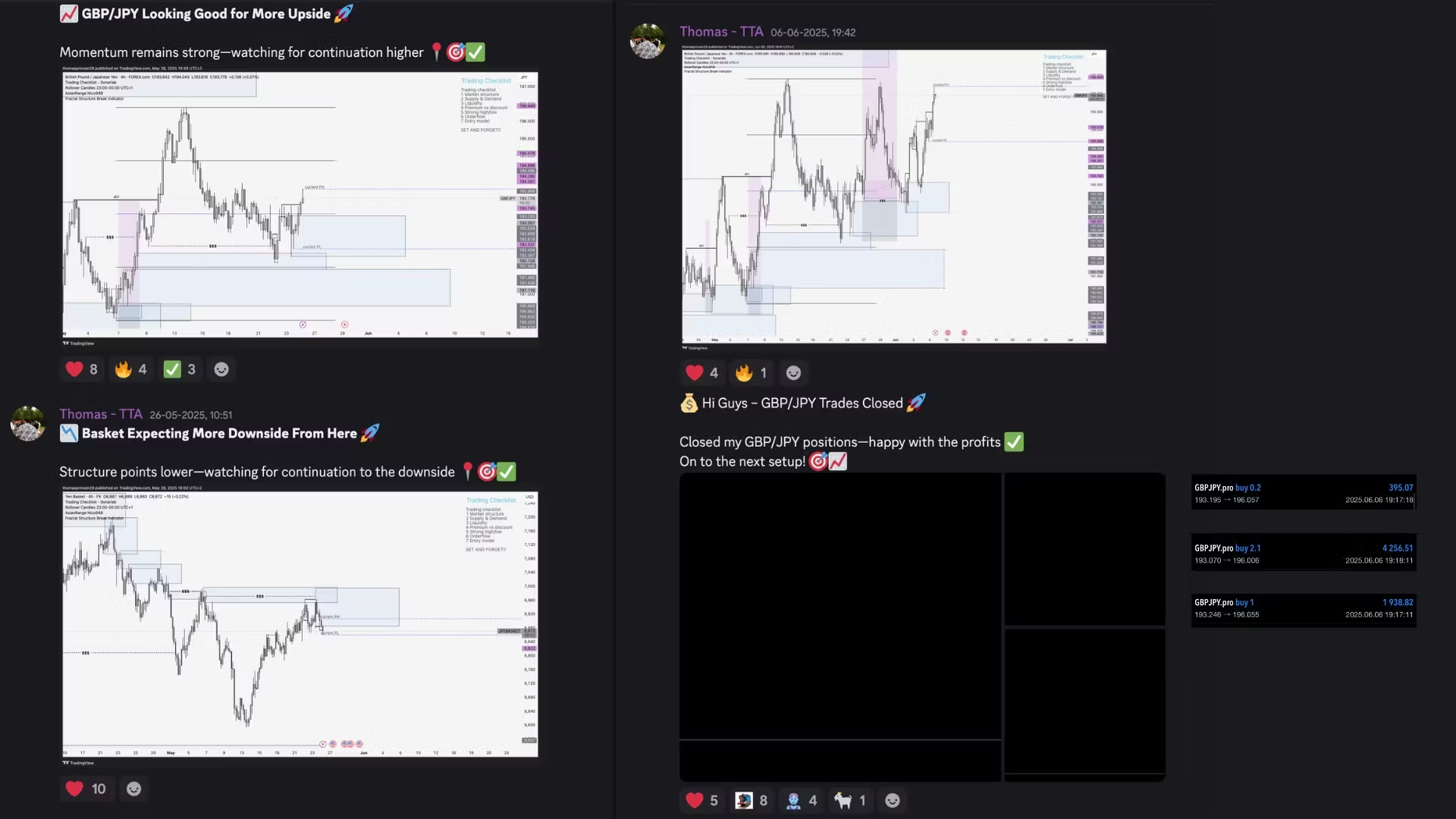
The public review themes around Fractal Structure Indicator and The Trading Academy are strongly positive. Members repeatedly point toward clarity, useful education, community support, and a tool that helps structure become easier to apply. That matters because indicators often fail when they look impressive visually but do not help the trader make better decisions.
One of the strongest themes is practicality. Members describe the tool as something they can apply to real chart work rather than a complicated overlay that requires constant interpretation. That is important for traders who already feel overwhelmed by indicators. A structure tool should simplify the chart, not make it harder to read.
Another theme is education around the tool. A market-structure indicator has more value when members understand what the marks represent. If the trader learns why a fractal high matters, why a reversal break is different from a continuation break, and why context changes the meaning, the tool becomes part of a learning process.
The community angle also appears important. A trader can learn faster when they see how other traders are applying the tool and where they may be making mistakes. Discussion around examples can help members avoid the common problem of treating every mark as equal.
The positive public response is especially relevant because TradingView indicators are a crowded category. Many tools promise precision, but only some help traders build a cleaner framework. Fractal Structure Indicator stands out when it is used as a structure and review tool rather than a signal generator.
For a beginner, those public themes suggest that the tool can make market structure easier to understand. For an intermediate trader, they suggest that the tool can improve consistency. For an advanced trader, they suggest that the tool may be useful for fast structure review without replacing discretion.
V. How To Use Fractal Structure Indicator Well
The best way to use Fractal Structure Indicator is to start with observation. Load it on a clean chart, choose a market you already follow, and study how the indicator marks fractal highs, fractal lows, continuation breaks, and reversal breaks. Do not immediately trade every mark. First learn how the tool sees structure.
Next, compare the indicator with your own manual structure. Mark the swings yourself before looking at the indicator. Then compare. Where did you agree? Where did you miss a swing? Where did you mark something that was not useful? This exercise can improve your chart reading faster than passive watching.
Use replay mode to study failed breaks and clean breaks. Failed breaks are especially valuable because they teach caution. A reversal break in a choppy range may not mean much. A continuation break after an extended move may be late. A structure shift after liquidity is taken may be more meaningful. The indicator helps you identify these events, but review teaches you how to interpret them.
Build a simple checklist. Before acting on a structure mark, ask whether the trend is clear, whether the level matters, whether the timing is reasonable, whether risk can be defined, and whether the setup matches your plan. If those answers are not clear, the mark is only information.
For beginners, use the tool to learn structure vocabulary. For intermediate traders, use it to reduce inconsistent marking. For advanced traders, use it to speed up backtesting and refine edge cases. The same indicator can serve different skill levels if the trader uses it with the right intention.
Most importantly, track outcomes. If you use the indicator for a month, write down which structure events created useful context and which ones did not. The goal is to build evidence around how the tool fits your trading plan. That is how an indicator becomes part of a system instead of another chart decoration.
Final Take
Fractal Structure Indicator is a strong option for traders who want cleaner market-structure context inside TradingView. It is especially useful for traders studying fractal highs and lows, continuation breaks, reversal breaks, and the difference between real structure shifts and chart noise.
The best reason to join is not that the tool removes decision-making. It is that the tool can make structure easier to see, study, and review. For traders who want a more organized chart workflow, Fractal Structure Indicator is worth considering.
Frequently Asked Questions
What is Fractal Structure Indicator?
Fractal Structure Indicator is a market-structure tool that helps traders identify fractal highs, fractal lows, continuation breaks, reversal breaks, and structure shifts on the chart.
Who is Fractal Structure Indicator best for?
It is best for traders who use market structure in their process and want a cleaner way to visualize swing points and structure changes in TradingView.
Does Fractal Structure Indicator give automatic trade entries?
No. The indicator can highlight structure events, but traders still need to judge context, risk, timing, and whether the setup fits their plan.
Can beginners use Fractal Structure Indicator?
Yes. Beginners can use it to learn how structure forms, while more experienced traders can use it for consistency, replay, and backtesting.
Is Fractal Structure Indicator only useful for one market?
No. Market structure can be studied across many liquid markets, but each trader should test the tool on the markets and timeframes they actually trade.
