

This content is for informational and entertainment purposes only, not financial advice. Trading involves risk and is not suitable for all investors. This article may contain affiliate links, which means Pro Trading Insights may earn a commission if you sign up through a link. For full details, see our Affiliate Disclosure and Full Disclaimer.
Quick Verdict: Unity Traders is a Spanish-language SMC mentorship built around market structure, order flow, liquidity, live analysis, and direct trading education. The strongest appeal is the way it combines a structured course with community support and practical chart review, which makes it more useful than a simple alert feed for traders who want to understand the reasoning behind a setup.
Best fit: For someone comparing Unity Traders reviews, the key question is whether they want a mentor-led environment that explains how to read the chart step by step. Unity Traders makes the most sense for traders who want SMC concepts taught in a practical way, with enough support to move from scattered chart watching into a more organized routine.
Best Fit Snapshot
| Fit Area | Why It Matters |
|---|---|
| Spanish-language SMC learners | Unity Traders is especially useful for traders who want market structure, order flow, and liquidity explained in Spanish instead of trying to translate complicated chart concepts alone. |
| Live-analysis traders | The community angle is built around analysis, weekly projections, alerts, and support, which can help members connect theory to real market conditions. |
| Beginner-to-intermediate traders | The course path is positioned from basic concepts toward professional-level understanding, so it can work for people who need foundations and people refining an existing process. |
| Process-focused members | The best use case is building a trading routine around structure, levels, risk, and review instead of reacting to every short-term move. |
Table of Contents
I. Unity Traders Overview
Unity Traders is best understood as a mentorship-first trading community. The core focus is SMC-style trading, which means the education is centered on how price moves through structure, liquidity, order flow, and important reaction areas. Instead of treating every candle as a trade idea, the approach encourages traders to understand where the market is likely drawing attention and where a setup actually has context.
The public-facing material around Unity Traders is primarily Spanish, which is important. Many SMC explanations online are either in English, overly technical, or scattered across short social clips. A Spanish-language mentorship can be valuable because the concepts are easier to absorb when the examples, questions, and community discussion happen in the language the member actually thinks in.
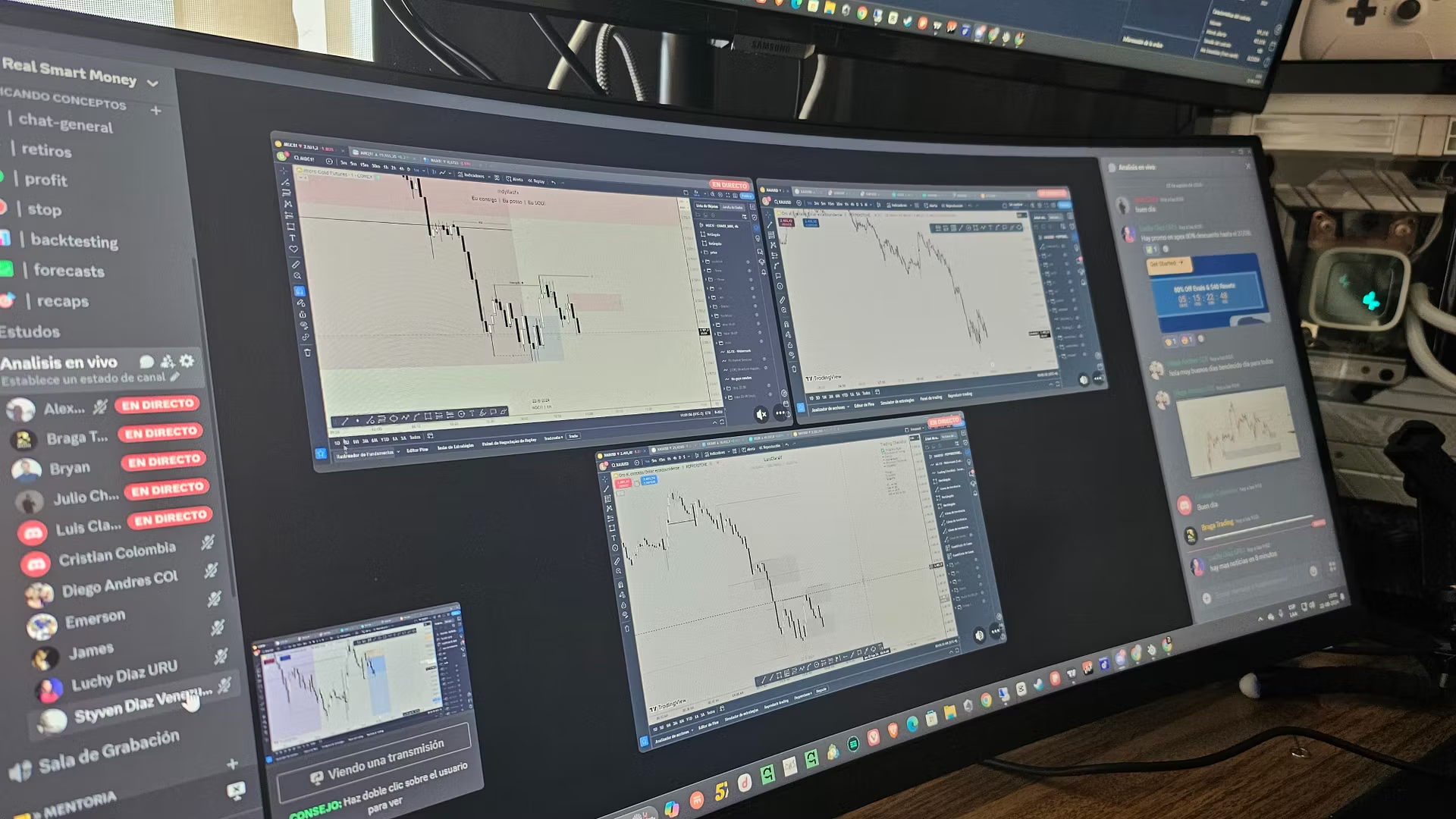
Unity Traders also has a practical orientation. The education is not only a library of theory. It includes live analysis, weekly projections, community discussion, trade alerts, TradingView tools, and direct support. That mix matters because SMC can become abstract if a trader only studies definitions. The concepts become clearer when a trader repeatedly sees structure, liquidity, and order flow applied to live charts.
The strongest fit is a trader who wants guidance without turning trading into blind copying. Alerts can help highlight areas of interest, but the real benefit is learning why an idea matters. When a member understands the reason behind an analysis, they can become more selective and less dependent on constant instructions.
For broader comparison, ProTradingInsights’ guide to top crypto trading Discord servers can help readers compare communities by alerts, education, market focus, and member support. The trading psychology guide is also a useful companion because any trading community works best when members already have rules for sizing, invalidation, and review.
II. SMC Mentorship And Chart Education
A. Learning structure before chasing entries
SMC trading can sound complicated at first because it uses terms like liquidity, order flow, displacement, structure shifts, inducement, and higher-timeframe context. The mistake many traders make is trying to memorize the words before they understand the chart behavior. Unity Traders is more useful when it helps a member connect those ideas to real examples.
Market structure is the foundation. A trader needs to know whether price is trending, ranging, reversing, building liquidity, or reacting from a meaningful area. Without that context, a trade alert is just another message. With that context, a trader can decide whether the idea fits the broader market behavior.
Order flow is the next layer. It helps a trader think about whether the market is showing strength, weakness, continuation, or a possible trap. That does not mean every move becomes predictable. It means the trader has a better way to ask questions before risking money. Is price moving with intent? Has liquidity already been taken? Is the market pushing into an area where a reversal is more likely, or is it simply continuing a stronger move?
Liquidity is where many SMC traders start to see the chart differently. Instead of assuming every breakout is clean, they learn to ask where orders may be sitting and why price may move through obvious levels before making the real move. Unity Traders can help when it turns that concept into repeated chart practice rather than vague theory.
B. A course path from foundations to practical execution
The course angle is important because not every member will arrive with the same experience. A beginner may need basic chart language, a clear explanation of how candles form around levels, and a simple way to avoid rushing into trades. An intermediate trader may already know the vocabulary but need a better routine. A more advanced trader may want sharper execution, cleaner review, and more disciplined filtering.
Unity Traders works best when the member treats the education as a progression. Start with foundations, study the examples, watch how live analysis is framed, and then compare that process against your own charts. The goal is not to memorize one perfect setup. The goal is to learn how the mentor thinks through structure and why certain areas matter more than others.
That is also why direct mentoring can be useful. Traders often misunderstand a concept because they apply it in the wrong context. They may call every pullback liquidity, every candle displacement, or every level important. A mentorship environment can help correct those mistakes faster because the member can see how a more experienced trader filters the chart.
III. Live Analysis, Alerts, And Community Support
The community side of Unity Traders is a major part of the value. A course can explain the strategy, but markets move every day. Live analysis, weekly projections, and group discussion help bridge the gap between learning and execution. That is especially useful for traders who feel confident while watching lessons but lose structure when the market opens.
Trade alerts can be useful when they are treated as educational context. A healthy member does not simply copy an alert and hope. They look at the chart, identify the level, ask why the idea is relevant, and decide whether it matches their own risk rules. The best alerts help train the eye. They show what the mentor is watching and why timing matters.
Live analysis is also valuable because it shows how a trader adapts when the market does not behave perfectly. A textbook example is easy to understand after the move is complete. The real test is whether a trader can stay patient while price is still developing. Unity Traders can support that skill by letting members see analysis unfold in real time, including when waiting is the right decision.
The community chat gives members a place to stay focused on the mentorship rather than random social noise. That matters because trading communities can easily become chaotic. A focused room around analysis, questions, and learning can help members keep attention on the process instead of chasing every market rumor.
TradingView indicators can add another layer of organization when used correctly. The tool should not replace judgment, but it can help members stay aware of important chart areas and review potential setups more consistently. For traders who already use TradingView, having that workflow inside the platform can reduce friction.
IV. Public Review Themes
The public review themes around Unity Traders are strongly centered on mentorship quality, patience, direct explanations, and support. Several reviewers focus on the human side of the mentorship: the feeling that the mentor is involved, committed, and willing to guide students through the process rather than simply handing them disconnected information.
That matters because SMC trading is easy to overcomplicate. A community can have charts, videos, and alerts, but the real value comes from clarity. Reviews that mention step-by-step teaching, useful information, and support suggest that members are responding to the way the material is explained, not only the fact that trading ideas exist.
Another theme is motivation through structure. When traders feel lost, they often jump from strategy to strategy. A mentorship can help when it gives them a path to follow and a reason to stay consistent long enough to learn. Unity Traders appears strongest for people who want that guided environment.
The public review footprint also shows that the audience is international and multilingual, which fits the broader SMC market. The content is especially relevant for Spanish-speaking traders, but the chart concepts themselves apply across futures, forex, synthetic indices, and other liquid markets where structure and liquidity matter.
That language fit should not be underestimated. A trader can lose a lot of value when they understand only part of the explanation or have to translate every concept in real time. Unity Traders can reduce that friction by giving Spanish-speaking members a place where the trading vocabulary, examples, questions, and feedback all live in a more natural learning environment.
The review angle is also stronger because the benefits are not vague. Members are responding to direct mentoring, useful information, chart detail, and support through the learning process. Those are the things a serious trader should care about. The membership is more compelling when the reader sees it as a place to build competence, not as a promise that every alert will be easy.
V. How To Use Unity Traders Well
The best way to use Unity Traders is to start with the education before leaning too heavily on alerts. Watch the foundation material, take notes on the main concepts, and build a small chart checklist. The checklist should cover trend, structure, liquidity, important levels, session timing, risk, and the reason a setup is worth attention.
During live analysis, compare the mentor’s view with your own. Before reading the full breakdown, mark the chart yourself. Ask where liquidity may be, which level matters, and what would make the setup invalid. Then compare your thinking with the analysis. That habit turns the membership into training rather than passive consumption.
For beginners, the first goal should be vocabulary and patience. Learn what structure means. Learn why not every candle matters. Learn why a good trader can skip trades. For intermediate traders, the goal should be filtering. Identify which setups are clean enough to study and which are too messy. For advanced traders, the goal should be refinement: better timing, better review, and fewer low-quality decisions.
After each week, review the major projections and live sessions. Save examples of clean reactions and failed ideas. The failed ideas are useful because they teach what not to force. A good membership should make a trader more selective, not more impulsive.
Risk discipline still has to come from the member. Unity Traders can provide education, analysis, and structure, but the member must decide position size, invalidation, and when to sit out. The more seriously a member treats that responsibility, the more useful the mentorship can become.
A strong first month would be simple: finish the foundation lessons, attend or review the live analysis, mark the same levels on your own chart, and write down the reason behind every trade idea you study. If the reason is not clear, do not treat it as a trade. Treat it as a learning point. That habit helps the member turn the community into a skill-building loop.
Final Take
Unity Traders is a strong fit for Spanish-speaking traders who want SMC mentorship with live analysis, practical chart education, community support, and a clearer routine around structure and liquidity. It is not best viewed as a shortcut. It is best viewed as a guided environment for learning how to read the chart with more discipline.
The best reason to join is the combination of education and support. If you want to understand why a setup matters, how live analysis is framed, and how SMC concepts can become part of a repeatable process, Unity Traders is a compelling option to review closely.
Frequently Asked Questions
What is Unity Traders?
Unity Traders is an SMC-focused trading mentorship built around market structure, order flow, liquidity, live analysis, alerts, TradingView support, and community education.
Who is Unity Traders best for?
Unity Traders is best for Spanish-speaking traders who want guided education, live chart analysis, and a more structured way to study SMC concepts.
Does Unity Traders only help beginners?
No. Beginners can use it to build foundations, intermediate traders can use it to improve filtering, and experienced traders can use it to refine chart review and execution discipline.
Does Unity Traders remove trading risk?
No. Trading involves risk. Unity Traders can support education and process, but members still need personal risk rules and disciplined decision-making.
Is Unity Traders just an alert room?
No. Alerts are part of the environment, but the stronger value is the mentorship, live analysis, chart education, and community support around understanding why a trade idea matters.
