

This content is for informational and entertainment purposes only, not financial advice. The authors are not professional traders. Trading involves risk and is not suitable for all investors. Decisions should be made with consideration from a financial advisor. This article may contain affiliate links. For full details, see our Affiliate Disclosure and Full Disclaimer.
Best fit: Active traders who want pre-market updates, TradingView indicator context, Discord discussion, and a more organized way to review market timing.
Best Fit Snapshot
| Best for | Traders who want pre-market updates, TradingView indicators, Discord access, and market-timing discussion. |
|---|---|
| Best member profile | Someone who likes using chart tools but wants a clearer routine around timing, levels, and daily market preparation. |
| Best learning angle | Using pre-market context and indicators together so a trade idea is reviewed before the market gets noisy. |
| Strongest reason to join | Trade The Unknown can help traders connect daily planning with on-chart tools instead of relying on scattered signals. |
Table of Contents
I. What Is Trade The Unknown?
Trade The Unknown is a Whop-based trading community connected to the Trade The Unknown route. The current public access page is live, and the existing product context centers on private Discord access, daily pre-market updates, TTU TradingView indicators, and a place to ask questions about levels, timing, and market reads.
The name fits the product angle. Active traders spend a lot of time trying to make uncertain markets easier to read. Indicators can help, but only when they are connected to a plan. Pre-market updates can help, but only when the trader reviews them before the market becomes emotional. Trade The Unknown is most useful when those pieces work together.
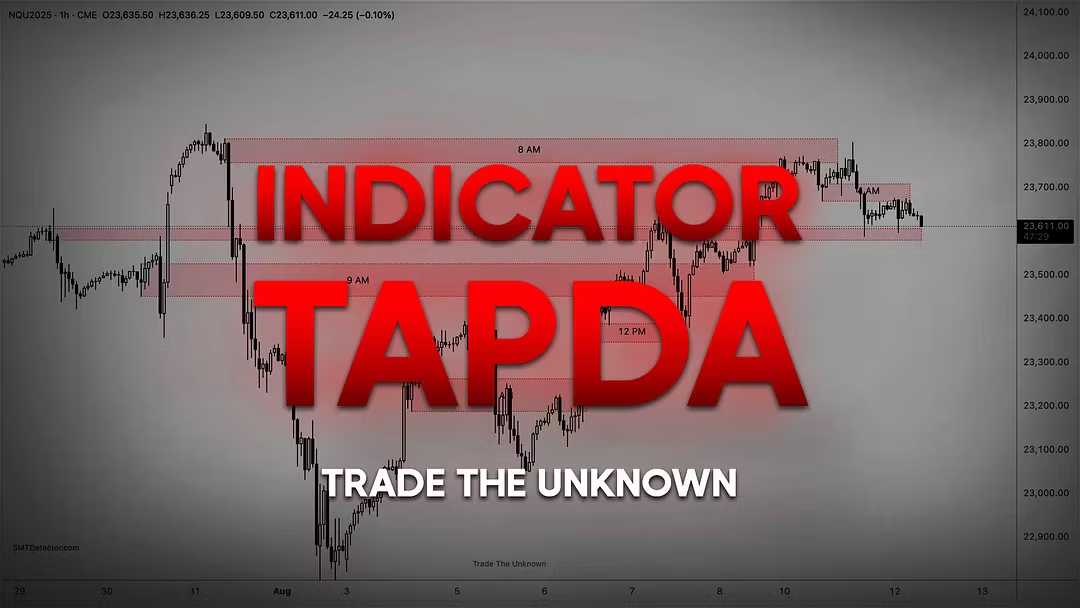
For beginners, a TradingView indicator is a chart tool that highlights certain market conditions. It does not remove the need for judgment. For intermediate traders, an indicator can help standardize what they are watching. For active traders, an indicator can become part of a broader routine around timing, liquidity, pre-market notes, and risk.
The important distinction is that Trade The Unknown is not just an alert room from the available product context. It is better understood as a workflow around pre-market updates, chart indicators, Discord discussion, and direct questions. That makes the membership more useful for traders who want structure around their own decision-making.
II. What Members Get Inside Trade The Unknown
The main pieces are private Discord access, pre-market updates, TradingView indicators, and direct question support. Those pieces are most valuable when they are used together. The update frames the day. The indicators help organize the chart. The Discord gives members a place to ask questions. The review process helps turn the day into a lesson.
The existing product context references TTU indicators such as TAPDA, Time Cycle Projections, Time Cycles, and Liquidity. The exact names matter less than the workflow they suggest. These are chart-based tools intended to help members think about timing windows, important areas, and market structure. They should support a plan, not replace one.
Pre-market updates can help members avoid starting the day cold. A useful pre-market note should frame bias, key areas, possible scenarios, and what would make the plan change. That kind of context is especially helpful when markets move quickly after the open.
The timing of the update matters. A pre-market read gives traders a chance to think before spreads, volume, and headlines begin moving the chart. That slower planning window can make a major difference for someone who tends to become reactive once the bell rings.
Private Discord access adds the community layer. If a member sees an indicator flash or a level react but does not understand why it matters, they can use the community to ask a more specific question. That is where the membership can become more educational than a tool-only setup.
Direct access to questions is valuable because trading tools can be misunderstood. A member may see the same indicator as another trader but interpret it differently. Being able to ask about the reasoning behind levels, timing, or a market update can reduce confusion and improve consistency.
The ideal workflow is not to add more and more signals. It is to make each piece earn its place. If an indicator supports the pre-market plan, it may deserve attention. If it contradicts the plan or arrives after the best part of the move, it can still be useful as a review point without forcing a trade.
If you are thinking about the broader role of chart tools, ProTradingInsights’ Trading Tools guide can help you compare how indicators, scanners, news feeds, and charting platforms fit into a trading process.
III. How The Indicator And Update Routine Works
The best way to use Trade The Unknown is to start before the market opens. Read the pre-market update, write down the bias, and mark the key areas that matter. Then open the chart and compare the TTU indicators against that plan. The goal is to prepare before volatility makes every move feel urgent.
During the session, the indicators should act like context prompts. If a timing window, liquidity area, or important level appears, compare it against the pre-market plan. Does it support the idea? Does it warn that the setup is late? Does it show a place where risk should be smaller or the idea should be skipped?
This is the difference between using indicators as tools and using them as excuses. A useful indicator helps organize attention. It should make the next question clearer: what is the setup, where is the risk, and what would prove the idea wrong?
Beginners should keep this simple. Pick one instrument, one timeframe, and one indicator concept to study. Write down what the tool appears to show and what happened afterward. Do not try to use every tool at once. A clean routine is more useful than a crowded chart.
A good beginner exercise is to mark the same level before the session and after the session. Before the session, write why that level may matter. After the session, write how price reacted. This helps connect the pre-market update, the indicator, and the real chart instead of treating them as separate pieces.
Intermediate traders can use the indicators to refine timing. If you already know the setup you want, the tool layer can help you decide whether the market is still near a reasonable area. This is where a pre-market plan and an indicator can work together.
Active traders can use the Discord layer for clarification. A specific question like “why did this liquidity area matter today?” is more useful than asking whether something should be taken. The goal is to understand the read, not outsource the decision.
News and catalysts can still matter. Indicators do not know every headline before it happens. If your process depends on catalysts, ProTradingInsights’ Benzinga Market News Analysis guide is a useful companion for thinking about how market-moving headlines fit into a pre-market routine.
IV. What Public Reviews Highlight
Public feedback around Trade The Unknown is most useful when it points to clarity, helpful updates, and support around the workflow. Because indicators can be interpreted in different ways, the quality of explanation matters as much as the tool itself.
| Public review theme | What it suggests for traders |
|---|---|
| Clear market updates | Pre-market context can help members know what to watch before volatility increases. |
| Indicator guidance | Members benefit when the tools are explained as part of a trading process rather than treated as magic signals. |
| Question support | Direct clarification can help traders understand levels, timing, and why a setup matters. |
| Practical routine | The best use case is a repeatable workflow: update, chart, question, review. |
Reviews should still be read carefully. Positive feedback can help explain why members like the community, but it does not guarantee trading results. The safer takeaway is whether the updates and tools help members think more clearly.
V. Who Trade The Unknown Fits Best
Trade The Unknown fits traders who like using chart tools but want more structure around them. If you already use TradingView and want a more guided way to combine indicators with daily market context, the membership has a clear use case.
It can work for beginners if they keep the setup simple. A beginner should not add multiple indicators and expect immediate clarity. The better first step is to learn what one tool is showing, compare it against the pre-market update, and review the outcome.
It can work for intermediate traders who need better timing. If you already have trade ideas but often enter too early or too late, a tool-and-update workflow may help create more consistent decision points.
It can also be useful for traders who already have too many inputs. Instead of adding Trade The Unknown on top of every other feed, use it to simplify. Compare the update, the indicator read, and your own plan. If those three do not line up, that is a reason to slow down.
It can also work for active traders who want another layer of pre-market preparation. The updates and indicators can help organize the session, while the Discord gives members a place to ask questions when the market read is unclear.
The fit is weaker for someone who wants passive investing, long-form portfolio analysis, or a community that makes every decision for them. Trade The Unknown is better for people who want tools, context, and discussion around their own trading process.
VI. How To Use Trade The Unknown In Your First Week
In the first week, start with the pre-market updates and one chart template. Add the TTU indicators, but do not overcrowd the chart. Pick one or two concepts to study and write down what you think each tool is showing.
Before the open, write a short plan: bias, key level, trigger, invalidation, and risk. During the session, compare indicator signals against that plan. After the session, review whether the tools helped you understand the market or made the chart more confusing.
Use Discord for specific questions. Ask about a level, a timing window, or a liquidity area. Avoid vague questions that only ask whether something is good or bad. The more specific your question, the more useful the answer is likely to be.
At the end of the week, decide whether the workflow made your trading process clearer. If it did, keep refining the setup. If it did not, simplify the chart and focus on fewer variables. A good indicator setup should reduce confusion, not add more of it.
The simplest success marker is clarity. If the update and indicators help you explain your plan in one or two sentences before acting, the workflow is doing its job. That matters in fast markets too.
VII. Trade The Unknown FAQ
What is Trade The Unknown?
Trade The Unknown is a Whop-based trading community built around private Discord access, pre-market updates, TTU TradingView indicators, and market-timing discussion.
What are TTU indicators?
TTU indicators are TradingView tools referenced in the product context, including tools around timing, cycles, and liquidity. They are meant to support chart analysis, not replace risk management.
Is Trade The Unknown only an alert service?
No. The stronger use case is the combination of pre-market updates, chart indicators, Discord questions, and review.
Who is Trade The Unknown best for?
It is best for active traders who already use charts and want more structure around indicators, timing, and daily market preparation.
How should beginners use Trade The Unknown?
Beginners should start with one chart, one or two indicator concepts, and the daily pre-market update before trying to use every tool at once.
Does Trade The Unknown remove trading risk?
No. Trading remains risky. Members still need their own position sizing, invalidation rules, risk limits, and independent judgment.
VIII. Final Take
Trade The Unknown is strongest for traders who want pre-market updates and TradingView indicators connected to a clearer routine. The membership makes the most sense when it helps members prepare before the open, interpret chart tools with more context, ask better questions, and review decisions after the session.
If you already use charts and want a more organized way to combine updates, indicators, and Discord discussion, Trade The Unknown is worth considering. Start with the pre-market plan, keep the chart simple, and use the tools to improve decision quality instead of chasing every signal.
