

This content is for informational and entertainment purposes only, not financial advice. Trading involves risk and is not suitable for all investors. This article may contain affiliate links, which means Pro Trading Insights may earn a commission if you sign up through a link. For full details, see our Affiliate Disclosure and Full Disclaimer.
Quick Verdict: Impulse Trading FX & Indices is a forex and indices education offer from Triggr Fingr that is built around precision, discipline, and structured decision-making. The product language uses the idea of a sniper-style approach, which is useful when understood correctly. It should not mean rushing into dramatic trades. It should mean waiting for better context, choosing cleaner locations, defining risk before entry, and avoiding random market participation.
Best fit: For someone comparing Impulse Trading FX & Indices reviews, the strongest reason to pay attention is the combination of structured videos, daily chart analysis, a trading handbook, and mentorship-style support. This looks best for traders who want a guided process for reading forex and index charts rather than a loose chat room that only posts market opinions. It should still be used as education and process support, not as a replacement for personal risk management.
Best Fit Snapshot
| Fit Area | Why It Matters |
|---|---|
| Forex and indices education | Impulse Trading FX & Indices is most relevant for traders who want to focus on currency pairs and index markets with a structured framework. |
| Sniper-entry structure | The precision angle is helpful when it trains members to wait for cleaner setups instead of taking every movement personally. |
| Chart analysis practice | Daily chart analysis can help members connect lessons to current market structure and improve pattern recognition over time. |
| Mentorship and handbook support | A handbook and mentorship calls can turn scattered lessons into a more repeatable routine. |
Table of Contents
I. Impulse Trading FX & Indices Overview
Impulse Trading FX & Indices is built for traders who want a more disciplined way to approach forex and index markets. The word “impulse” can sound like speed, but the better interpretation is controlled action after preparation. In liquid markets, the problem is rarely that there are no opportunities. The problem is that too many movements look tradable when the trader does not have a clear filter.
The sniper-entry language is useful because it points toward selectivity. A sniper-style trader is not supposed to be active every second. The idea is to wait for the right conditions, let price come into an area of interest, identify confirmation, and know exactly where the trade idea is wrong. That is especially important in forex and indices because both markets can move quickly around sessions, data, liquidity sweeps, and major support or resistance levels.
Impulse Trading also stands out because it appears to mix course material with ongoing market context. A static course can teach concepts, but a newer trader often needs to see those concepts applied to current charts before they really connect. Daily chart analysis can help bridge that gap. It gives members a way to see how the ideas are framed in real market conditions without treating every chart as an order to trade.
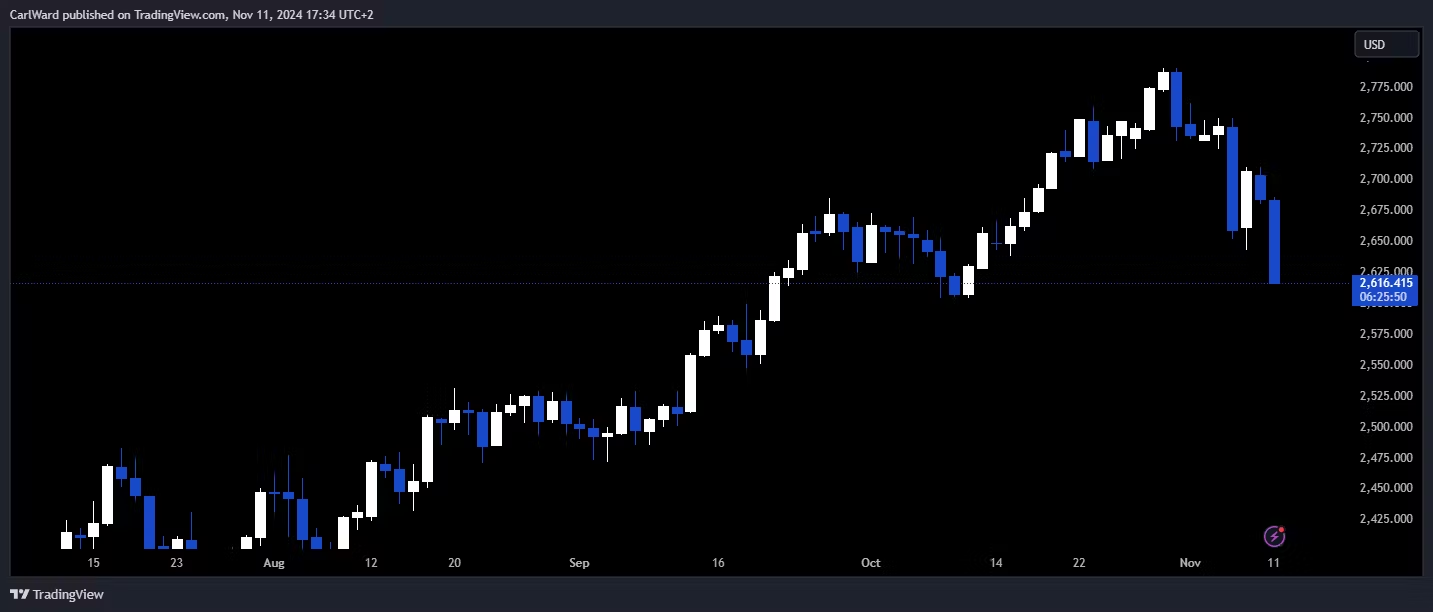
For broader comparison, ProTradingInsights’ guide to top crypto trading Discord servers can help readers compare communities by alerts, education, market focus, and member support. The trading psychology guide is also a useful companion because any trading community works best when members already have rules for sizing, invalidation, and review.
II. What You Get Inside Impulse Trading
Structured videos for key concepts
The foundation of Impulse Trading FX & Indices is structured video education. That matters because forex and index trading can become confusing when someone tries to learn from scattered clips, random screenshots, and disconnected terminology. A video sequence gives members a path. It can explain what matters first, what comes next, and how the pieces connect during a session.
For a beginner, the most useful concepts are usually market direction, session context, support and resistance, liquidity, entry confirmation, risk, and trade review. Those ideas are not valuable because they sound advanced. They are valuable because they help a trader decide when to do nothing. A clear lesson should make the member more selective, not more impulsive.
Daily chart analysis
Daily chart analysis is one of the more practical pieces of the offer. Markets change every day. The underlying principles may stay consistent, but the actual areas of interest move. Seeing charts reviewed regularly can help members understand how a strategy adapts without abandoning its rules.
That can be especially useful for indices, where price often reacts around major session opens, previous highs and lows, and news-driven volatility. A member who studies daily analysis can learn to ask better questions: What is the larger direction? Where is liquidity likely resting? Is the move already extended? Where would the idea be invalid? Those questions make the education more actionable.
Trading handbook and preparation routine
A handbook can be valuable when it turns lessons into written rules. Traders often understand a concept while watching a video but forget it under pressure. A handbook gives them something to review before the session. It can become a checklist for preparation, risk, trade selection, and review.
The best use of a handbook is practical. Before trading, a member can review what conditions must exist. During the session, they can compare the live chart to the written criteria. After the session, they can review whether the plan was followed. That routine helps prevent a course from becoming passive content.
Mentorship calls and replay value
Mentorship calls can help members connect the material to their own questions. A course may explain the strategy, but a member still needs to understand where they personally struggle. One person may be entering too early. Another may be ignoring higher-timeframe context. Another may be taking trades without a defined invalidation point.
The ability to revisit calls later is also important. Not everyone learns at the same pace. A recorded mentorship environment lets a member replay explanations and compare them against their own notes. That is useful for people who want to learn carefully instead of trying to absorb everything in one sitting.
App setup and workflow support
The offer also includes tutorials around setting up the tools members use. That may sound basic, but it matters. A trader who spends the first week fighting with charts, alerts, templates, or platform settings is not focused on learning the strategy. Clear setup support can reduce friction and make the rest of the education easier to follow.
For newer traders, tool setup can also reduce mistakes. If the chart is messy, the time zones are confusing, or the wrong instrument is being watched, even good lessons can become hard to apply. A clean workspace helps members focus on the actual process.
III. How It Fits Different Trader Levels
Beginner traders
Impulse Trading FX & Indices can work for beginners who want a defined education path and are willing to learn slowly. The important point is that forex and indices can move quickly, so a beginner should not treat the group as permission to trade aggressively. The first goal should be understanding structure, risk, and why certain trades are skipped.
A beginner should use the videos and handbook to build vocabulary. What is an entry? What is a stop? What is a target? What is confirmation? What does it mean for a chart to be clean or messy? Once those ideas are clear, the member can use daily analysis to see how they appear in real market conditions.
Intermediate traders
Intermediate traders may benefit because the offer can help tighten selection. Many intermediate traders already know basic technical analysis but still take too many trades. They see patterns everywhere because they have not defined which conditions are worth acting on. Impulse Trading’s precision angle can help them focus on fewer, better-defined ideas.
For this group, the best use is comparison. Before looking at the daily analysis, write your own read. Then compare it to the Impulse framework. Did you mark the same area? Did you miss a liquidity level? Did you assume direction too quickly? That kind of comparison can sharpen decision-making.
Advanced traders
Advanced traders may not need basic forex definitions, but they can still use Impulse Trading as a process check. A strong trader can benefit from seeing another structured approach to entries, risk, and market preparation. The value is not in copying every idea. It is in stress-testing whether the framework improves patience and clarity.
Advanced traders should be selective. They can focus on the chart analysis, mentorship discussions, and any parts of the handbook that improve preparation. If the group reinforces discipline and clean execution, it can still be useful even for someone with an existing strategy.
IV. Public Review Themes
The visible review themes for Impulse Trading FX & Indices point toward patience, supportive mentorship, clear examples, quality course content, and a teaching style that helps members feel more confident while learning. That pattern fits the product’s positioning. The offer is not only about posting charts. It is about helping traders understand how to think through forex and indices with more discipline.
Those review themes matter because forex education can easily become too vague. A member may hear that they need to be patient, but they still need someone to show what patience looks like on a chart. Positive feedback around clear examples and calm guidance suggests that the teaching style may be one of the strongest parts of the offer.
The best interpretation is that Impulse Trading is most attractive for people who want a mentor-led learning experience with structure. It may not be the ideal fit for someone who only wants a fast alert feed. Its stronger use case is education, preparation, and developing a cleaner trading routine.
V. How To Use Impulse Trading Well
The best way to use Impulse Trading is to build a pre-session routine. Start with the handbook and videos. Choose one or two concepts to focus on each week. Do not try to apply every idea at once. If the week is about market direction, focus on direction. If the week is about entries, focus on entry rules. If the week is about risk, focus on invalidation and position sizing discipline.
During the session, watch the daily chart analysis with a notebook. Write down the areas of interest, the reason those areas matter, and the condition that would make the setup invalid. This keeps the analysis from becoming passive. Instead of simply agreeing with a chart, the member learns to explain it.
After the session, review your own decisions. Did you wait for confirmation? Did you trade outside the framework? Did you enter because the plan was present or because the market was moving? Those questions are where the education becomes useful. A good trading group should make your process clearer, not just make you feel busy.
VI. Why The Precision Angle Works
The precision angle works when it reduces unnecessary trades. Many forex and indices traders are drawn to these markets because they move. Movement creates opportunity, but it also creates temptation. Without a clear process, a trader may confuse volatility with quality. A precise framework helps separate a market that is simply active from a market that is actually offering a defined setup.
Impulse Trading’s structure can help members think in stages. First, identify context. Second, mark areas that matter. Third, wait for confirmation. Fourth, define risk. Fifth, review the result. That sequence is simple, but it is powerful because it makes the trader answer the right questions before acting.
This is also why the mentorship and handbook support matter. Precision is not only about the entry candle. It is about preparation, patience, execution, and review. A trader who learns to wait for the right conditions may take fewer trades, but the trades they do consider are more intentional.
Final Take
Impulse Trading FX & Indices is a strong fit for traders who want forex and indices education, structured videos, chart analysis, handbook support, and mentorship around disciplined entries. It looks best for beginners and intermediate traders who want to become more selective and understand why a setup deserves attention.
The most important point is to use the group as a learning system. If you want a more organized way to read forex and index charts and build a cleaner routine, Impulse Trading FX & Indices is worth reviewing closely.
Frequently Asked Questions
What is Impulse Trading FX & Indices?
Impulse Trading FX & Indices is a forex and indices education offer from Triggr Fingr focused on structured videos, chart analysis, handbook support, and disciplined trade selection.
Is Impulse Trading good for beginners?
It can be useful for beginners who want a guided path and are willing to learn market structure, risk, and confirmation before trading aggressively.
What does sniper-entry structure mean?
In this context, sniper-entry structure means waiting for cleaner market conditions, better locations, defined confirmation, and clear invalidation before considering a trade.
Does Impulse Trading include chart analysis?
Yes. Daily chart analysis is part of the practical value because it helps members see how the education applies to current forex and index markets.
Can Impulse Trading guarantee results?
No. Impulse Trading is an education and mentorship-style offer. Trading involves risk, and every member is responsible for their own decisions and risk management.
